2. The Teardown Economy
If you own a 1950s house in Paramus, the most likely buyer for it may not plan to live in it.
Two of every three single-family houses in the Borough were built between 1945 and 1975 (5,101 of 7,636). They are ranches, capes, splits and bi-levels with a median of 1,990 square feet. Since 2015, 528 of the Borough's lots have had a new house built on them, and 292 of those date from 2020 or later.6 The State's permit count shows the pace: 25 houses demolished in 2015, 57 in 2023, 52 in 2024.7
Paramus is not adding houses. It is replacing them, one lot at a time, and that single fact now sets the price of the old house, the price of the new one, and the tax bill on both.
This matters whether you are selling, buying under $1 million, or buying at $2 million.
What a teardown actually is
The deed record shows the whole sequence. The State publishes every deed transfer in Paramus; the Borough tax list shows what stands on each lot today. Put the two together and you can find every lot where an older house was sold and a house built in 2020 or later now stands.8
There have been 206 of those purchases since January 2020.
The house that was bought was built in 1952 and had 1,514 square feet, at the median. The house on the same lot today has 4,013.
| Year of purchase | Teardown purchases | Median paid for the old house |
|---|---|---|
| 2020 | 30 | $523,750 |
| 2021 | 41 | $625,000 |
| 2022 | 35 | $650,000 |
| 2023 | 40 | $705,000 |
| 2024 | 40 | $795,000 |
| 2025 | 20 so far | $830,000 |
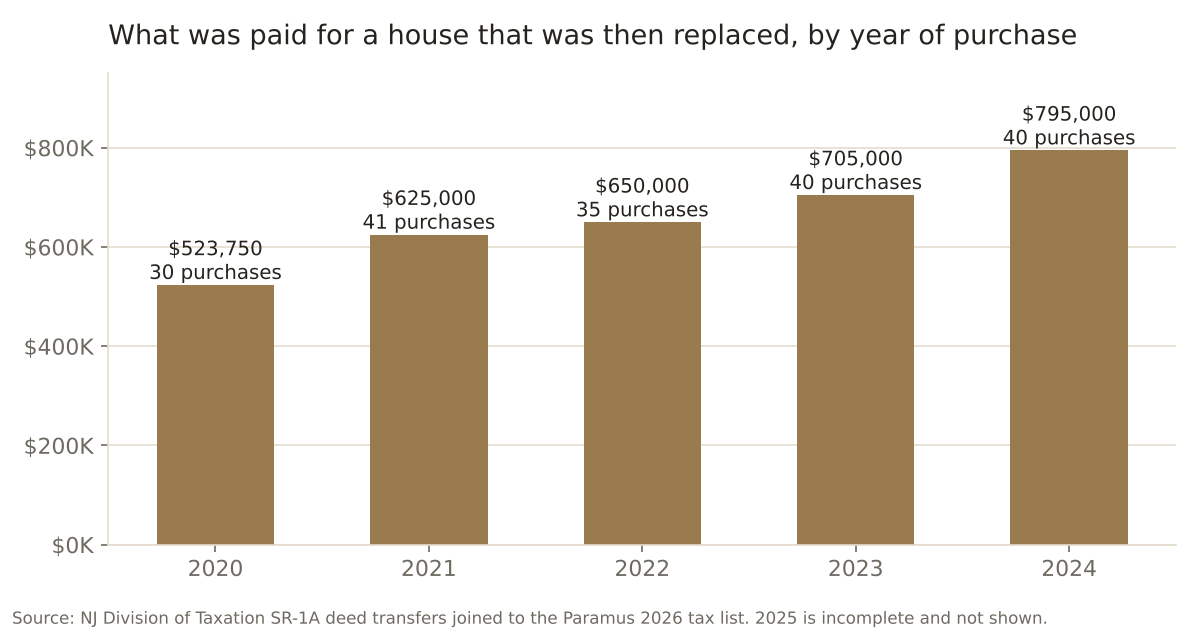
A purchase shows up in this count only after the new house is finished and on the tax roll, which takes a year or two. So the 2025 figure will keep rising as those houses are completed, and 2026 purchases are not visible yet. It is not a slowdown.
The price paid for a house that will be taken down rose 52 percent from 2020 to 2024.
What this means for you
If you own one of these houses, the floor under your price is set by what the lot is worth to someone who will rebuild on it, and that floor has been rising faster than the market as a whole: from 2021 to 2024 it rose 27 percent, while the median single-family sale price rose 17 percent ($769,000 to $901,000).9
The rule of thumb
In 116 cases the deed record shows both halves: the old house bought, and the new house on the same lot sold.8
| Same-lot pairs, 2020 to June 2026 | Median | Middle half |
|---|---|---|
| Price paid for the old house | $653,500 | $561,500 to $750,000 |
| Price the new house sold for | $2,025,000 | $1,715,000 to $2,250,000 |
| Gross spread | $1,380,000 | $1,089,000 to $1,600,000 |
| Months from one deed to the next | 19 | 14 to 23 |
The new house sold for 3.1 times what the old one cost. Turned around, that is the rule of thumb:
- The old house on a standard lot is worth about a third of what a new house on that lot will sell for
- New houses sold at a median of $2,225,000 in 2025; the old houses they replaced had cost $725,000
- A lot that is narrow, irregular or on a corner is worth less to a builder than its area suggests (Section 14 explains why)
What recent cases actually look like
| Year the new house sold | Lots | Median paid for the old house | Median new-house price | Median gross spread |
|---|---|---|---|---|
| 2022 | 18 | $567,500 | $1,810,927 | $1,225,000 |
| 2023 | 21 | $625,000 | $1,720,000 | $1,175,000 |
| 2024 | 20 | $680,000 | $2,115,000 | $1,455,000 |
| 2025 | 35 | $725,000 | $2,225,000 | $1,575,000 |
| 2026 to June | 15 | $808,000 | $2,150,000 | $1,375,000 |
2021 is left out: only seven lots completed the cycle that year, too few for a median to mean anything.
Gross spread is not profit. It is one sale price minus another. It does not include demolition, construction, architect and engineering fees, permits, interest and taxes during a 19-month hold, or the cost of selling. None of those appear in any public file, and this report does not estimate them. What the table does show is direction: in the first half of 2026 the old house cost $83,000 more than in 2025 and the new house sold for $75,000 less. The margin for whoever builds is getting thinner, which is worth knowing if a builder is the one making you an offer.
The public files also leave the buyer and seller names blank, so this report cannot say how many builders are active or who they are.8
If you own a 1950s ranch, cape or split
Of 176 teardown purchases since 2021, 63 (36 percent) cannot be found as a closed sale on the New Jersey Multiple Listing Service.10 For comparison, the same test on every other sale of an older Paramus house in those years finds 26 percent missing, so some of the gap is ordinary: a sale through another listing service, or an address typed differently. The difference between the two figures is the part that points to private offers.
The houses that did go through the listing service sold at a median of 102.7 percent of asking in 14 days, and 60 percent sold above asking.
A builder prices your lot from the finished house, not from the old one. In each year from 2022 through 2025, the median paid for a teardown was 37 to 38 percent of the median new-construction sale price that year (42 percent in 2021).8, 10 New construction sold at a median $2,340,000 in 2026 (Section 3). At the same share, that points to about $870,000 to $900,000 for a typical lot today. That is arithmetic from past sales, not an appraisal of any one lot.
Builders pay by the lot, not by the square foot. Divide what was paid by the size of the lot, and the teardown purchases of 2024 and 2025 come to a median of about $74 per square foot of land, up from about $46 in 2020.8, 6 But the price hardly moves with the size of the lot.
| Lot size | Median paid, 2024 and 2025 | Per square foot of land |
|---|---|---|
| Under 9,375 sq ft | $760,000 | about $86 |
| 9,375 to 10,999 sq ft | $804,444 | about $80 |
| 11,000 sq ft or more | $825,000 | about $65 |
A lot gets one house whatever its size, so the largest lots are a third bigger than the smallest and sold, at the median, for about $65,000 more. But the range inside each group is wide. Lots of 12,500 square feet or more sold for $680,000 to $950,000, and what separates the top from the bottom is the lot itself: its width, its shape and its zone. In the R-100 zone, where lots are 100 feet wide, the median was $840,000, against $805,000 in R-75. A lot that can legally be divided in two is worth more again, and few Paramus lots can be.
What this means for you
A letter or a knock on the door offering to buy your house "as is, no commission" is an offer for your lot. Before you answer it, find out what lots like yours have sold for. The median was $795,000 in 2024 and $830,000 in 2025. The assessor's land value on your tax record, a median of $445,300 for these houses, is not that number.6 And judge an offer against what lots like yours sold for, not by multiplying a price per square foot by the size of your lot.
What I tell my sellers: more than a third of the older homes that builders bought in Paramus never went on the market. When one of those owners gets a private offer, there is nothing to compare it with. The homes that were listed sold for a median of almost 3 percent over asking in two weeks, and six in ten sold above asking. So before you say yes to an offer that arrives in the mail, let me show you what lots like yours have actually sold for. You can still take the private offer; you should know what you are giving up first.
If you are buying under $1 million
You are bidding against the people who will take the house down.
From 2021 through 2024, 99 of the 628 single-family sales under $1 million on the listing service (16 percent) were teardown purchases. The share rose each year from 2022: 13 percent, 18 percent, then 20 percent in 2024 (26 of 133).10 A buyer who will demolish does not need the kitchen to work, does not ask for repairs and is not depending on an appraisal of the house.
That is part of why this is the band that sells over asking. In the twenty months to October 2, 2026, houses listed under $800,000 sold at a median of 103.0 percent of asking and those from $800,000 to $1 million at 101.1 percent, with more than half of each going above the list price.9
What this means for you
On a tired house on a 75-foot lot, assume at least one competing offer has no inspection or mortgage condition. Section 4 covers what it takes to win. And look at the lot the way a builder would, because that is who you will be selling to one day.
If you are buying a new house at $2 million or more
This is where the supply is, and where you have room.
Of the 71 homes listed at $2 million or more that closed in the last twenty months and could be matched to the tax list, 67 (94 percent) were built in 2015 or later, and 52 (73 percent) were new construction.10 The top of the Paramus market is, for practical purposes, the output of the teardown purchases above.
| October 2, 2026 | Under $800K | $800K to $1M | $2M and up |
|---|---|---|---|
| Active listings | 5 | 6 | 18 |
| Months of supply | 1.5 | 1.1 | 5.1 |
| Median percent of asking, last 20 months | 103.0% | 101.1% | 97.5% |
| Sold above asking | 58% | 56% | 11% |
| Median days on market | 16 | 18 | 40 |
Since 2021, half of all listings at $2 million and up ended without a sale: 114 sold, 37 expired and 75 were withdrawn. Many of those were relisted under a new number, so the true share that never sold is lower, but no other band comes close; under $800,000 the figure is 16 percent.9
What this means for you
At $2 million and up you are the scarce party. The median buyer paid 2.5 percent under the list price, one in four paid more than 6 percent under, and there were 18 houses to choose from against roughly three and a half sales a month. Ask how long the house has really been for sale, including any earlier listing.
Why the rules allow it
Many towns cap the size of a house as a fraction of its lot, called a floor area ratio. Paramus does not. Its code says "there shall be no maximum floor area ratio"; a house is limited by its yards, a 25 percent cap on building coverage, a 50 percent cap on all hard surface, and height.11 On the standard 75 by 125 foot lot that works out to roughly 4,700 gross square feet where a 1,900 square foot house stands, as Section 14 shows.
A house that fits those limits is built as of right. There is no variance and no design review. The one public hearing most rebuilds get is before the Planning Board for a soil moving permit, required when more than 400 cubic yards is moved, which a full basement usually exceeds. Demolition itself takes a construction permit and a $3,000 deposit.12
What this means for you
If the house next door is sold to someone who will rebuild, you will not be asked. The soil hearing is the place to raise truck routes, retaining walls and where the roof water goes. If you are the one building, it means time and certainty, which is why 19 months from purchase to resale is possible here.
The tax bill, and the number that is wrong on the listing
The land under an old house and the land under a new one are assessed about the same. The building is the difference.6, 13
| 2026 assessments | Houses | Median living area | Median land value | Median total assessment | Tax at the 2025 rate |
|---|---|---|---|---|---|
| Built 1945 to 1975 | 5,101 | 1,990 sq ft | $445,300 | $773,000 | $11,587 |
| Built 2020 or later | 292 | 3,929 sq ft | $444,450 | $1,849,000 | $27,717 |
Same street, same lot size, about $16,000 a year apart.
Here is the part no listing site shows. When the new house in each of the 116 pairs was sold, the assessment on the books was a median of 37.9 percent of the price paid, and in 70 of the 116 it was under half.8 The record still described the old house, or the land alone. The tax on that assessment was about $11,700. The same 116 lots carry a median 2026 assessment of $2,020,450, which is about $30,300 at the 2025 rate. The gap has been closing as the annual reassessment picks new houses up sooner: for new houses sold in 2025 the median was 48.8 percent, and for those sold in the first half of 2026 it was 97.2 percent, with 2 of 15 under half.
Paramus reassesses every property every year, so the gap does not wait for a town-wide revaluation.14 A house finished during the year is picked up by an added assessment: it is valued from the first of the month after completion, billed for the remaining months, and that bill is due November 1.15 New houses in the pairs that sold in 2025 are already assessed at a median of 97.4 percent of what the buyer paid.
Practical consequence: the tax line on a new-construction listing has, more often than not, described a house that no longer exists. Ask what assessment it is based on, and budget from the price instead: the State's effective rate for Paramus was 1.434 percent of market value in 2025, which is about $28,700 a year on $2 million (Section 9).13
For the neighbor who is not rebuilding: a new house next door does not reassess yours. Your assessment follows sales of houses like yours.
Where it concentrates
Rebuilding is happening across the Borough, on the lots the code makes easiest.
- By zone. The R-75 zone (75-foot lots) holds 68 percent of the single-family houses, 85 percent of the teardown purchases since 2020 (176 of 206) and 94 percent of the pairs (109 of 116). In R-75, 8.6 percent of houses were built in 2015 or later; in R-100, 3.4 percent.6
- By area. The blocks residents call Ridge Ranch, bounded by Midland Avenue, Forest Avenue, Century Road and Route 17, hold 24 percent of the Borough's single-family houses, 37.5 percent of those built since 2015 (198 of 528), 39 percent of the teardown purchases (80 of 206) and 47 percent of the pairs (55 of 116). One house in nine there is now less than twelve years old, against one in eighteen elsewhere. Section 17 gives the block list and the figures by census tract.
What this means for you
On a block of 75-foot lots, expect construction within sight at some point during a five-year hold, and expect the new houses to become the comparable sales for the street.
The owner-builders
More than a third of the new houses in Paramus were built by the people who live in them. Of the 528 houses built since 2015, 333 were sold as finished houses. The other 195 (37 percent) were rebuilt and never resold, and on 166 of those the tax bill goes to the house itself, which is what you see when the owner lives there.6
These are residents, not builders. Some bought an older house in order to replace it. Others took down the house they already lived in: 34 of the 130 who bought the old house did so four or more years before the new one went up, and another 65 have owned the lot so long that there is no sale on record at all.8 A tax-bill address is strong evidence that the owner lives there, though it is not proof, and a few of the most recent ones may be new houses still waiting for a buyer.
What this means for you
Buying the old house and building your own is an established route here, not an exotic one, and the same as-of-right rules apply to you as to a builder. Price it honestly. You will pay what builders pay for the lot, carry it through construction, and receive the full assessment within a year of moving in.
What to do
- Owners of an older house: look up what teardown lots sold for in the last twelve months before answering any private offer, and get a second number from the open market
- Buyers under $1 million: check the lot (frontage, shape, corner or interior) as carefully as the house; it is what your competition is pricing
- Buyers of new construction: ignore the tax figure on the listing and use 1.434 percent of your price; ask for the full listing history
- Anyone building: read Section 14 before you buy, and count the 50 percent hard-surface limit before you plan a pool
- Neighbors: watch the Planning Board agenda for soil moving permits on your street
What I tell my buyers: in Paramus you are really choosing between two markets that share the same streets. Under $1 million you are competing with people who value the lot more than the house, so decide your number before the open house and expect to pay over asking. At $2 million and up there are five months of supply and half the listings since 2021 did not sell the first time, so take your time and negotiate. Either way, I work out the tax from the price you are paying, because on a new house the figure on the listing sheet has usually been the old house's, and the median shortfall has been about $15,000 a year.
I’ll walk you through what any of this means for a specific house, your budget, or your tax bill. No obligation, and nothing to sign up for.