4. What It Takes to Win
The question every buyer asks is some version of "how much over asking do I need to go?" In Paramus the honest answer depends on which side of $1 million you are on, and for half the market the answer is "less than you fear." Here is the range behind it rather than a single number.
The competitive zone
Under $1 million, where almost half of Paramus houses sell, this is how the last twenty months of closings came out:
| Close price as a percent of asking | |
|---|---|
| One in ten homes sold below | 96.2% |
| A quarter of homes sold below | 99.1% |
| Half sold below, half above | 101.2% |
| Three-quarters sold below | 109.7% |
| Nine in ten sold below | 113.7% |
Single-family closings listed under $1 million, February 1, 2025 through October 2, 2026.18
| How the house sold | Share of homes under $1 million |
|---|---|
| Below asking | 27% (about one in four) |
| At or above asking | 73% (almost three in four) |
| At least 5% over asking | 42% (four in ten) |
| At least 10% over asking | 25% (one in four) |
| At least 15% over asking | 8% (about one in twelve) |
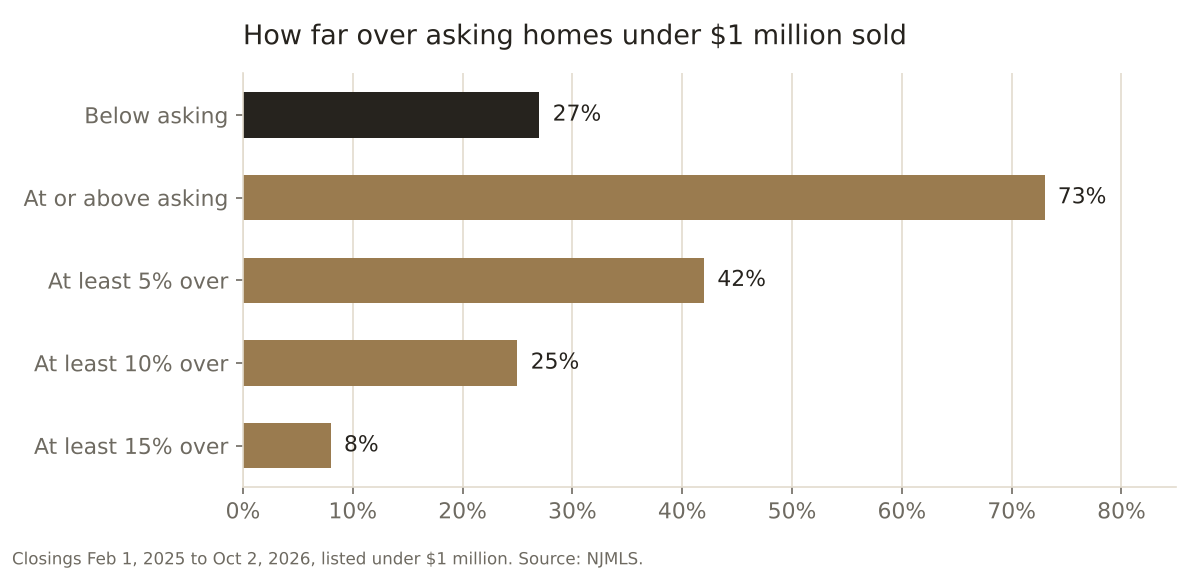
An offer at asking price in this range is a real offer. It is the middle of the field, not the back of it. But the field is wide: the house you want may be one of the quarter that goes 10 percent over, and the way to tell which kind it is, before you write, is how long it has been on the market.
| Days from listing to accepted offer | Sales | Share of sales | Percent of asking paid | Sold above asking |
|---|---|---|---|---|
| 14 days or fewer | 78 | 44% | 108.3% | 86% |
| 15 to 21 days | 21 | 12% | 108.0% | 71% |
| 22 days or more | 78 | 44% | 100.0% | 24% |
Same 177 sales.18
A Paramus house under $1 million that is going to draw a contest draws it in the first three weeks, and those houses sell for about 8 percent over asking. One that is still available on day 22 sells at asking, and three times in four at or below it. These are close to two separate populations.
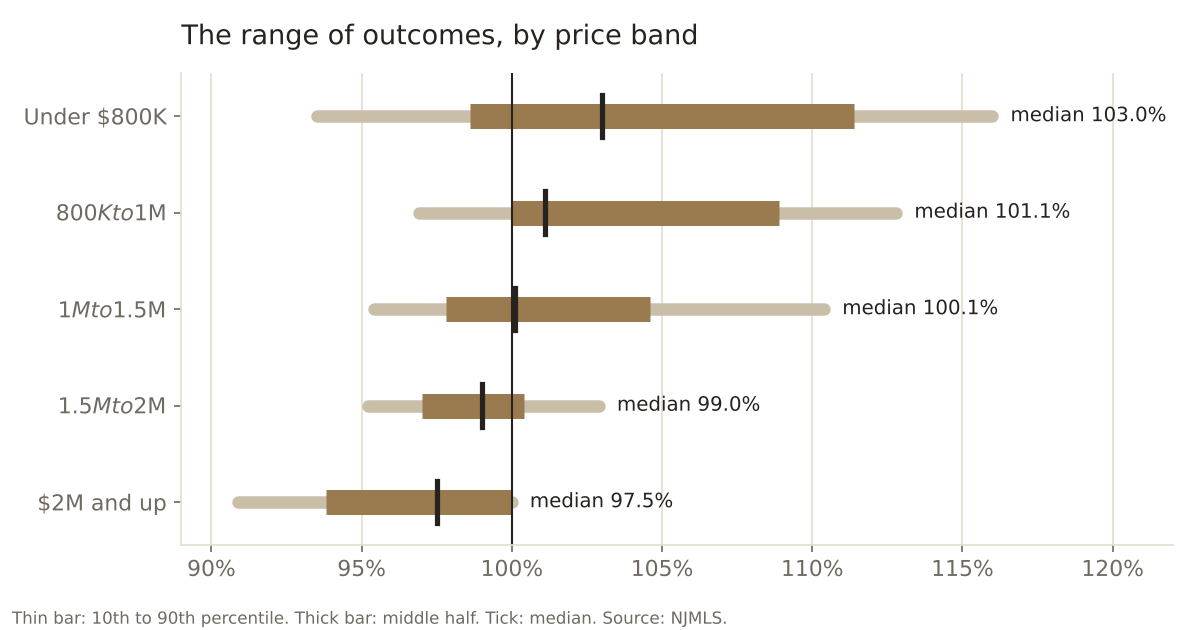
Here is the full picture by band:
| List price band | n | One in ten sold below | A quarter sold below | Middle | Three-quarters sold below | Nine in ten sold below |
|---|---|---|---|---|---|---|
| Under $800,000 | 65 | 93.5% | 98.6% | 103.0% | 111.4% | 116.0% |
| $800,000 to $1 million | 112 | 96.9% | 100.0% | 101.1% | 108.9% | 112.8% |
| $1 million to $1.5 million | 65 | 95.4% | 97.8% | 100.1% | 104.6% | 110.4% |
| $1.5 million to $2 million | 54 | 95.2% | 97.0% | 99.0% | 100.4% | 102.9% |
| $2 million and up | 75 | 90.9% | 93.8% | 97.5% | 100.0% | 100.0% |
Single-family closings February 1, 2025 through October 2, 2026.18
The one-line version
At $900,000 in Paramus, expect to pay asking to 2 percent over, expect other offers a little more than half the time, be ready to go 9 or 10 percent over for a house in its first two weeks, and expect to decide within about 18 days.
Adjust from there:
| If you are buying at | Plan for | When it is contested | Sold above asking | Decision window |
|---|---|---|---|---|
| Under $800,000 | About 3% over | 11% over or more, one time in four | 58% | About 16 days |
| $800,000 to $1 million | About 1% over | 9% over or more, one time in four | 56% | About 18 days |
| $1 million to $1.5 million | Asking | 5% over or more, one time in four | 52% | About 20 days |
| $1.5 million to $2 million | About 1% under; negotiate | Rarely more than 3% over | 30% | About 35 days |
| $2 million and up | 2% to 6% under; negotiate | Almost never over asking | 11% | About 40 days |
"Sold above asking" is the share of closings above final list price, used here as the best available measure of how often a house drew competing offers. Sample sizes as in the table above.18
Price is not the whole offer
These numbers describe price. They do not describe the other terms that decide contests between offers that are close on price: inspection scope, mortgage and appraisal contingencies, attorney review posture, deposit size, closing date, and whether the seller needs to stay a few weeks after closing.
In Paramus there is a specific reason terms matter under $1 million. Some of your competition is a builder buying the lot (Section 2). A builder typically does not need a mortgage contingency or a long inspection, and does not care about the kitchen. A family buying the same house cannot always match those terms and should not try to match all of them. What you can do is know before you write whether the house is a likely builder target, and shape the offer for that. Do not read the percentages above as a bidding instruction. They describe the field. The strategy is the conversation we have about your specific house.
The eighteen-day reality
Paramus gives a buyer some time to decide. It does not give as much as the 18-day figure suggests.
Most houses come out for the weekend. Of the 371 houses that sold in the last twenty months, 70 percent had their first day of showings on a Thursday, Friday, Saturday or Sunday. Saturday is the single most common day (22 percent), then Thursday (19 percent) and Sunday (16 percent). Monday and Tuesday together are 16 percent.19 Launches lean on the open-house weekend itself.
The contested ones are gone by the second weekend. Under $1 million, 44 percent of sold houses had an accepted offer within 14 days, and the two most common single days were day 9 and day 14: one weekend of showings, then a decision early the next week or after the second weekend.
Right now is a little slower than the average. Of the 40 single-family homes under contract or in attorney review on October 2, 2026, the median took 21.5 days from first showing to accepted offer; the middle half took 13 to 48 days. Only 7 of the 40 went in ten days or fewer. For the 18 of those listed under $1 million the median was 16.5 days.19 Accepted offers in Paramus show up in week two or three.
Mortgage rates are the likeliest reason. The average 30-year rate was 7.28 percent in the first week of October 2026, up from 6.34 percent a year earlier.20 On a $920,000 loan, which is what a buyer at the Paramus median borrows with 20 percent down, that is about $577 more every month for the same house. Buyers who have to qualify at the higher payment take longer to commit, and some drop out. The sales data cannot prove that rates caused the slowdown, but the timing fits, and it fits the price pattern too: the existing-home median was flat from 2025 to 2026 (Section 3).
What this means for you
If you are buying, you have a little more time to decide than a buyer had a year ago, and a seller whose house has passed the three-week mark knows it. If you are selling, price for the buyer who is paying 7 percent, not the one who was paying 6.
What that means in practice: you can usually see a Paramus house twice, and you can usually get an inspector's opinion before the deadline rather than after. You cannot start your pre-approval after you find the house. A listing in its first weekend should be treated as a ten-day decision; a listing in its fourth week is one where you can ask the seller a question and wait for the answer.
What I tell my buyers: look at the days on market before you look at the price. A house under $1 million in its first two weekends will probably cost you 5 to 10 percent over asking and you need your paperwork done before you walk in. The same house on day 25 will most likely sell at asking, and nobody else may be writing that week. It is the same market on both days, so check the calendar before you decide how hard to bid.
The exception worth knowing
At $2 million and up it is a different market, and most of it is new construction sold by builders.
- 72 percent of these homes sold below asking, and only 11 percent above it.
- One in three (32 percent) sold at 95 percent of asking or less. One in ten sold at 91 percent or less. On a $2.4 million house, 95 percent is $120,000 off the list price.
- The 66 sales identified as new construction closed at a median 98.2 percent of asking after a median 40 days. The 19 existing homes sold at $2 million and up closed at 95.7 percent.21
- Remember the note in Section 3: these percentages are against the final list price. A house that cut its price before selling gave up more than the table shows.
The $1.5 million to $2 million band is the transition. Three in ten homes there still sell above asking, but the median is 1 percent under and the house takes 35 days.
If you are shopping at $2.3 million, the strategy that wins at $850,000 is not just unnecessary. It is expensive. Offer below asking, ask for what you want finished or upgraded, and take your time. The builder across the table has a construction loan, taxes and a calendar, and Section 5 shows how many competing new houses are for sale at once.
I’ll walk you through what any of this means for a specific house, your budget, or your tax bill. No obligation, and nothing to sign up for.